TL;DR: The Electronic Frontier Foundation's Atlas of Surveillance counts more than 1,500 US law enforcement agencies operating drone programs, with EFF's 2026 Street Level Surveillance project documentation noting the multi-year expansion. In May 2025, the FAA streamlined its drone waiver process for first responders and approved 410 waivers in just two months, nearly a third of all waivers ever granted. Programs in Milwaukee, Philadelphia, Las Vegas, and Missouri are expanding from emergency response into routine policing. The drones carry HD cameras, thermal imaging, license plate readers, and, increasingly, AI-powered analytics. But privacy rules, data retention limits, and facial recognition restrictions haven't kept up. Fourteen people have already been wrongfully arrested because police relied on facial recognition technology. Now that same technology is heading skyward, and almost nobody's writing the rules for it.
The Numbers Are Staggering
More than 1,500 US law enforcement agencies now fly drones, according to the EFF's Atlas of Surveillance dataset [1][3]. The figure reflects years of post-2018 expansion. And then the FAA poured fuel on the fire.
In May 2025, the FAA finalized a reworked waiver process for "Drone as First Responder" (DFR) programs. The old process took months. The new one takes weeks, sometimes hours [2]. What happened next was predictable: in the first two months alone, the FAA approved 410 waivers, roughly a third of the approximately 1,400 DFR waivers it had ever issued [3].
That's not gradual adoption. That's a floodgate.
Flock Safety (the surveillance company behind automated license plate readers in thousands of communities) secured $275 million in March 2025, partly to fund its drone expansion through its Aerodome acquisition [4]. Their technology already serves over 5,000 US communities. Their drone programs are projected to reach 100 cities by 2026. Clark County, Nevada (Las Vegas) planned to purchase 400 drones for first-response deployment [1].
Sold as Emergency Response. Used for Everything Else.
Every police drone program starts the same way: find missing hikers, respond to active shooters, survey disaster zones. Nobody opposes that. The problem is what happens after the press conference.
Milwaukee launched its DFR pilot in January 2026 with 12 drones [5]. The pitch was straightforward: send a drone to emergency calls before officers arrive, give them real-time information, save lives. But Milwaukee had already been using drones for "event management" since the 2024 Republican National Convention. That means crowd monitoring. At protests. The Wisconsin ACLU noted that ICE has maintained protester databases and Milwaukee saw documented protester surveillance during 2020 [5].
"We don't want to ban this technology, but we want to have more guardrails on it," the Wisconsin ACLU told WUWM [5]. That's a measured position. But guardrails require someone to build them, and Wisconsin's 2013 drone law permits law enforcement use for "legal operations" without defining what that means.
Philadelphia is further along, and further gone. The Philadelphia Police Department has operated 21 drones since launching its program in Kensington in 2024, racking up nearly 8,000 deployments [6]. During one 30-day stretch, drones averaged 32 flights daily. The program expanded to North Philadelphia's 22nd District and the 15th District in Northeast Philly.
The department's directive technically prohibits routine neighborhood patrol, facial recognition, and interference with First Amendment activities. But a Philadelphia Inquirer investigation found the program "has largely operated without the type of independent oversight and transparency that other cities rely on to guard against misuse" [6]. Boston requires annual surveillance reports. Illinois mandates state reporting. Los Angeles required civilian board approval. Philadelphia? City Council imposed zero restrictions.
Police Commissioner Kevin Bethel called drones "a great force multiplier, vs. me having cops on roofs with binoculars" [6]. That's exactly the problem. Binoculars don't have thermal imaging. They don't auto-track. They don't upload footage to cloud servers linked to real-time crime centers.
What These Drones Actually Carry
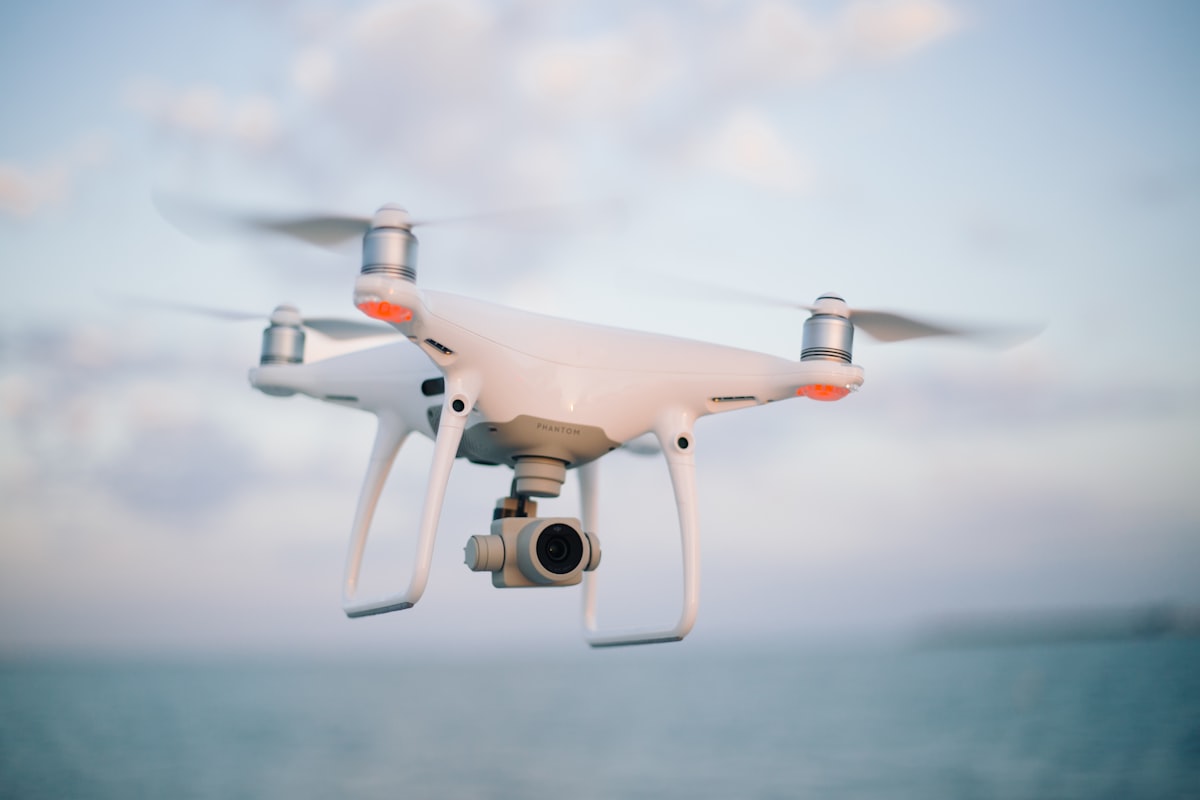
A modern police drone isn't a camera with propellers. It's an integrated surveillance platform. According to Biometric Update's May 2026 investigation, today's police drones are equipped with [7]:
- High-definition live-feed video cameras: streaming directly to command centers
- Thermal infrared imaging: seeing through darkness, walls of vegetation, even detecting recent footprints
- Automated license plate readers: Flock Safety integrated ALPRs directly into drone systems in 2025 [3]
- AI-powered video analytics: detecting vehicles, people, bags, weapons, crowds, and "unusual movement"
- Automatic tracking: following targets with minimal human intervention
- Cloud storage and video management: footage uploaded to systems shared with other surveillance data
- 3D environmental mapping: via partnerships like Paladin and SkyeBrowse [3]
And then there's the FBI. In November 2025, the FBI issued a Request for Information seeking vendors who can build AI-enabled drones capable of facial recognition, license plate recognition, and weapons detection [8]. They want drones that identify people from the air. Automatically.
Chula Vista, California pioneered the DFR model. Their drones respond to domestic violence calls, disturbances, and homelessness-related investigations [1]. Read that list again. These aren't active shooter situations. They're routine policing calls where a surveillance drone now shows up first.
14 Wrongful Arrests and Counting
The facial recognition problem isn't theoretical. It's already here, on the ground. Adding drones just makes it worse.
The ACLU has documented at least 14 wrongful arrests caused by police reliance on facial recognition technology [9]. The cases span nine states: Maryland, Michigan, Missouri, Louisiana, Nevada, New Jersey, North Dakota, Florida, and Arizona. Most of the victims are Black.
Kimberlee Williams spent six months in jail (23 days in Oklahoma, three months in Montgomery County, two months in Prince George's County) because Maryland police relied on an incorrect facial recognition match and then concealed their use of the technology from the court when applying for arrest warrants [9]. The charges were dropped in December 2021. Six months of her life, gone.
Robert Williams was arrested in front of his family on his lawn in Detroit. Porcha Woodruff was eight months pregnant when Detroit police arrested her on a faulty facial recognition match. Nijeer Parks spent 10 days in jail in New Jersey. The list goes on: Michigan, Missouri, Georgia, Louisiana, Nevada, Arizona, New York, North Dakota, Florida [9].
Now connect the dots. Police drones carry cameras. Those cameras stream to cloud systems. Those cloud systems connect to real-time crime centers. Real-time crime centers use facial recognition. Philadelphia's directive says drones can't use facial recognition, but the footage feeds into the same system as body camera recordings [6]. What happens when someone runs that footage through a facial recognition system after the fact?
As Biometric Update noted: "Facial recognition restrictions in some cities may not cover drone footage unless broadly written" [7]. Most aren't broadly written. Most weren't written with drones in mind at all.
The Data Retention Black Hole
Here's the question nobody can answer: how long do police keep drone footage?
Biometric Update's investigation identified data retention as "one of the least resolved issues" in police drone programs [7]. Agencies may retain footage if classified as evidence, training material, intelligence, or part of an ongoing investigation. Those categories are broad enough to keep almost anything forever.
Milwaukee's program logs deployments in a public tracker, one of the few that does. But data retention policies remain undefined [5]. Philadelphia promised a "public-facing drone transparency dashboard" that hasn't materialized [6]. The department also allowed drone footage to be used in a manufacturer's promotional video, raising questions about who else gets access to surveillance footage.
Most police drone policies regulate flight operations: how high, how far, which airspace. They don't regulate what happens to the data after the drone lands [7]. That's a policy framework built for RC hobbyists, not for an aerial surveillance network covering thousands of communities.
The funding makes it worse. Police drone programs are funded through a patchwork of municipal budgets, federal grants, state homeland security programs, private donations, police foundations, asset forfeiture funds, and vendor pilot programs [7]. DHS alone announced $115 million in counter-drone investment for the 2026 FIFA World Cup and America250 celebrations. When money flows from that many sources, accountability fragments.
The Law Is Still in 1989
The legal framework governing police aerial surveillance dates to Florida v. Riley (1989), a Supreme Court case that said police can observe your backyard from a helicopter without a warrant [1]. That was 37 years ago. The court was talking about human eyeballs in a helicopter, not AI-powered cameras on autonomous drones that can hover over your neighborhood 24/7.
Wisconsin permits drone use for "legal operations." That's it: no specifics, no limits [5]. Most states are similar. Only a handful have meaningful restrictions. Minnesota requires agencies to report drone usage data, which revealed that 93 agencies deployed drones 1,171 times in 2020, with nearly half (506) being training exercises and zero deployments related to terrorism [1].
Over 20 jurisdictions have banned police use of facial recognition technology [9]. Detroit implemented a settlement prohibiting officers from requesting arrest warrants based "only a photo lineup combined with a facial recognition-based lead." Indiana enacted similar protections into state law in 2025 [9]. But these restrictions were written for ground-level cameras and mugshot databases. Almost none explicitly cover drone-captured footage.
Civil rights attorney David Rudovsky, who was initially consulted on Philadelphia's drone policy, called the department's directive full of "red flags," including the lack of warrant requirements and broad language around narcotics investigations [6]. Philadelphia Councilmember Rue Landau asked the question that matters: "How many people in Philadelphia even know that the police department has drones?" [6]
The Real Threat: Workflow Convergence
The biggest risk isn't any single technology. It's how they combine.
Drones carry cameras. Cameras feed real-time crime centers. Crime centers run facial recognition, license plate readers, gunshot detection, and predictive policing algorithms. Flock Safety (the same company building out drone programs) already integrates ALPRs with drone footage [3]. Axon, the Taser and body camera company, partnered with drone maker Skydio in 2024 [3]. Motorola Solutions partnered with Brinc for DFR programs [3].
Each piece looks reasonable in isolation. A drone responds to a 911 call: fine. An ALPR reads a plate at a checkpoint: fine. A camera streams to a command center: fine. But together, they create persistent aerial surveillance linked to identification databases, with automatic tracking, cloud storage, and AI analytics. That's not emergency response. That's a surveillance infrastructure that didn't exist five years ago, built without legislative authorization, funded through fragmented grants nobody tracks.
As Biometric Update put it: "The question is whether the same systems, funded through fragmented grants and local procurement, will quietly create routine aerial monitoring without meaningful democratic control" [7].
Based on the last seven years of expansion, the answer is yes. It's already happening.
What You Can Do
- Check if your city has a drone program. The EFF's Atlas of Surveillance tracks police drone deployments by jurisdiction. Look up your city and county
- File public records requests. Ask your police department for drone deployment logs, data retention policies, and any contracts with surveillance technology vendors. MuckRock provides free templates
- Demand a local drone ordinance. Push your city council to pass drone-specific regulations covering: warrant requirements, data retention limits, facial recognition bans, public reporting requirements, and civilian oversight board approval
- Support state-level restrictions. Contact your state legislators and push for drone surveillance bills that include warrant requirements, data retention limits, and explicit facial recognition bans that cover drone footage
- Show up at city council meetings. Drone programs are often approved in budget hearings and public safety committee meetings with minimal public attendance. Your presence matters more than you think
The Bottom Line
In 2018, around 600 police agencies flew drones. Today it's over 1,500. The FAA approved 410 new waivers in two months. Flock Safety is racing to put drones in 100 cities. The FBI wants facial recognition drones. Philadelphia runs 32 drone flights a day with no council oversight.
Every one of these programs started as emergency response. None of them stayed that way. The drones are already flying. The rules are still on the ground.
References
- Electronic Frontier Foundation: Drones and Robots: Street Level Surveillance (2026)
- Commercial UAV News: "FAA Streamlines Drone Approval Process for First Responders" (2025)
- Electronic Frontier Foundation: "Drone as First Responder Programs: 2025 in Review" (December 2025)
- DroneLife: "Flock Safety Secures $275M Funding, Accelerates Drone Expansion" (March 2025)
- WUWM 89.7 FM: "Milwaukee Police Are Using Drones. Critics Cite Surveillance Concerns" (2026)
- Philadelphia Inquirer: "Philadelphia Police Expand Drone Use, but With Little Oversight From Above" (April 13, 2026)
- Biometric Update: "Police Drone Programs Raise Questions About Use of AI, Facial Recognition" (May 11, 2026)
- The Intercept: "The FBI Wants AI Surveillance Drones With Facial Recognition" (November 2025)
- ACLU: "More Than a Dozen Wrongful Arrests Due to Police Reliance on Facial Recognition Technology" (2026)
Published: May 13, 2026